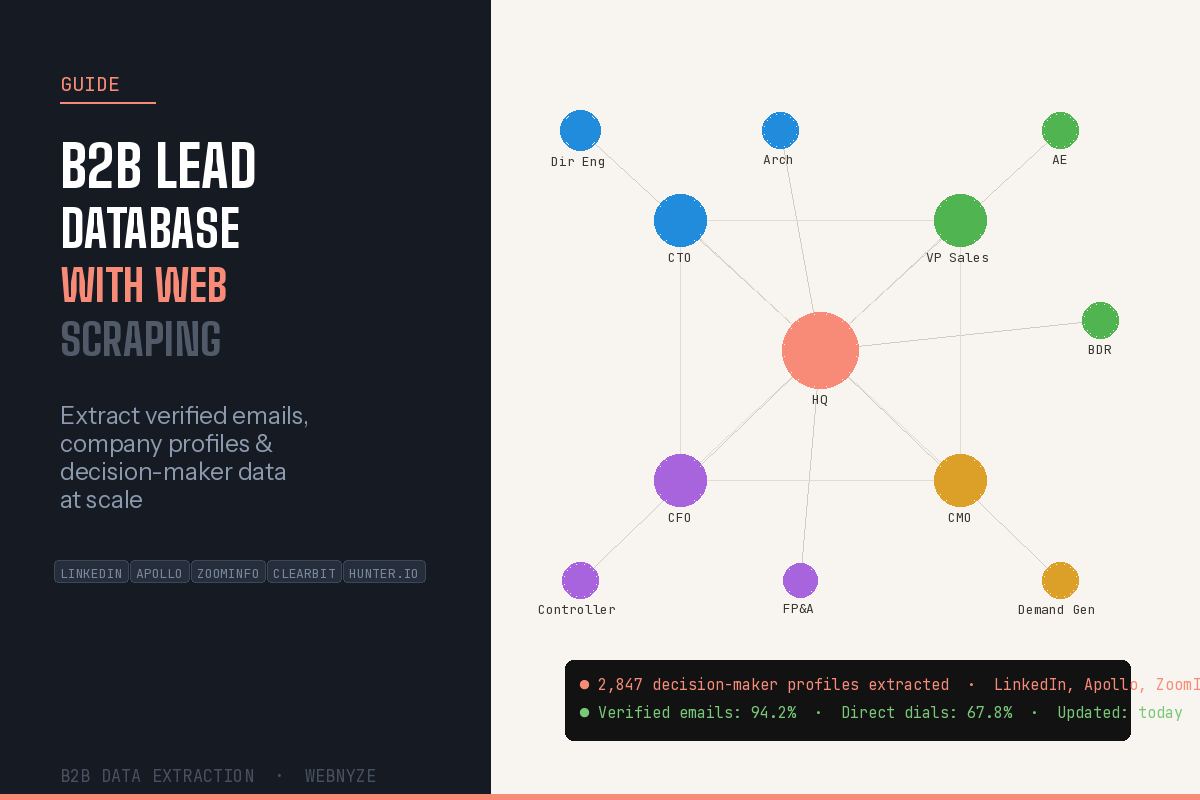
B2B sales teams live and die by the quality of their prospect data. Buying lead lists from data vendors gives you stale, generic contacts that every competitor also has. Building your own lead database through web scraping gives you fresh, targeted, and exclusive prospect data that's tailored to your ideal customer profile.
Where to Find B2B Lead Data
The web is full of publicly available business information. The challenge is collecting it at scale and structuring it into something useful. Here are the primary source categories:
Business Directories and Registries
- Industry directories: Clutch, G2, Capterra, ThomasNet, Kompass — rich company profiles with services, reviews, and size indicators
- Government registries: Companies House (UK), SEC EDGAR (US), MCA (India), ABN Lookup (Australia) — official registration data, directors, and filing history
- Chamber of commerce listings: Local business directories with contact details and industry classifications
- Yellow pages and maps: Google Maps, Yelp, Yellow Pages — good for local business data with addresses, phone numbers, and hours
Professional Networks and Job Boards
- Company career pages: Job postings reveal tech stack, team structure, growth signals, and hiring budget
- Conference and event listings: Attendee lists, speaker rosters, and sponsor directories from industry events
- Professional association member directories: Industry-specific associations often publish member lists
Company Websites
- About/Team pages: Executive names, titles, bios, and sometimes email patterns
- Contact pages: Phone numbers, addresses, and department-specific emails
- Technology footprints: Analyzing the tech stack visible in page source (analytics tools, CMS, frameworks) to identify technology buyers
Data Points to Extract
A high-quality B2B lead record includes:
- Company data: Name, website, industry, employee count, revenue range, founding year, headquarters location, and office locations
- Contact data: Decision-maker names, job titles, email addresses, phone numbers, and professional profile URLs
- Firmographics: SIC/NAICS codes, technology stack, funding history, and recent news mentions
- Intent signals: Job postings (hiring for specific roles), technology adoptions, content engagement, and event participation
Email Discovery and Verification
Finding the right email address is often the hardest part. Our approach:
Pattern Detection
Most companies use predictable email formats: first.last@company.com, first@company.com, or flast@company.com. We identify the pattern by finding one or two confirmed addresses (from press releases, author bylines, or contact pages) and then apply it across all contacts at that company.
Multi-Source Verification
Every email goes through a verification pipeline:
- Syntax check: Valid email format and domain exists
- MX record lookup: Verify the domain has active mail servers
- SMTP verification: Check if the specific mailbox exists without sending an email
- Catch-all detection: Flag domains that accept all addresses (lower confidence)
- Disposable email detection: Filter out temporary email addresses
After verification, each email gets a confidence score: high (verified mailbox), medium (valid domain, catch-all), or low (pattern-guessed, unverified). We typically achieve 85–92% deliverability rates on high-confidence emails.
Data Enrichment Pipeline
Raw scraped data is just the starting point. We enrich leads with additional context:
- Technology stack detection: Analyzing company websites to identify CMS, analytics, marketing automation, and infrastructure tools they use
- Company news monitoring: Flagging companies that recently raised funding, made acquisitions, or announced expansion plans
- Social presence scoring: Company activity levels across social platforms as a proxy for marketing maturity
- Hiring velocity: Number of open positions as an indicator of growth trajectory
Keeping Data Fresh
B2B data decays fast. People change jobs, companies get acquired, phone numbers get reassigned. We combat data decay with:
- Scheduled re-scraping: Key data sources are re-crawled on a weekly or monthly cycle
- Change detection: We track changes to company pages and directory listings, flagging updates to job titles, contact info, and company details
- Bounce monitoring: If you share email bounce data with us, we automatically re-verify and update those contacts
- Deduplication: Continuous matching to merge duplicate records and maintain a single source of truth
CRM Integration and Delivery
We deliver lead data in formats ready for your sales workflow:
- Direct CRM import: Formatted CSV files matching Salesforce, HubSpot, or Pipedrive import schemas
- API integration: Push new leads directly into your CRM via API as they're discovered
- Enrichment overlay: Match against your existing database to fill in missing fields and update stale records
- Segmented lists: Pre-segmented by industry, company size, geography, technology stack, or intent signals
Compliance Considerations
B2B lead scraping must be done responsibly:
- GDPR: In the EU, business contact data is still personal data. You need a legitimate interest basis and must provide opt-out mechanisms
- CAN-SPAM / CASL: Email outreach laws in the US and Canada require clear identification, physical address, and unsubscribe options
- Source compliance: We only extract data from publicly accessible sources and respect each site's terms of service
- Data minimization: We only collect the data fields you actually need — no bulk hoarding of unnecessary personal information
Ready to build a targeted prospect database for your sales team? Request a free sample of leads matching your ideal customer profile.