For years, counter-drone technology lived in demo territory. Government agencies ran tests, manufacturers showed off detection systems at trade shows, and procurement programmes crawled through evaluation cycles that lasted longer than the threats evolved. That era is over.
Something shifted in late 2025, and it wasn't subtle. Russian drones violated airspace over Belgium, Germany, Denmark, and Norway — overflying NATO military bases and civilian nuclear sites. Iran launched simultaneous drone swarm attacks against nine countries in February 2026. The US Air Force handed Trust Automation a $490 million indefinite-quantity contract. The Department of Homeland Security stood up a permanent counter-drone office. The EU published a continent-wide Action Plan. Congress passed the Safer Skies Act, unlocking over $1.1 billion in FEMA grants for state and local counter-drone purchases. And the FIFA World Cup is coming to eleven American cities this summer, generating its own dedicated $625 million C-UAS procurement wave.
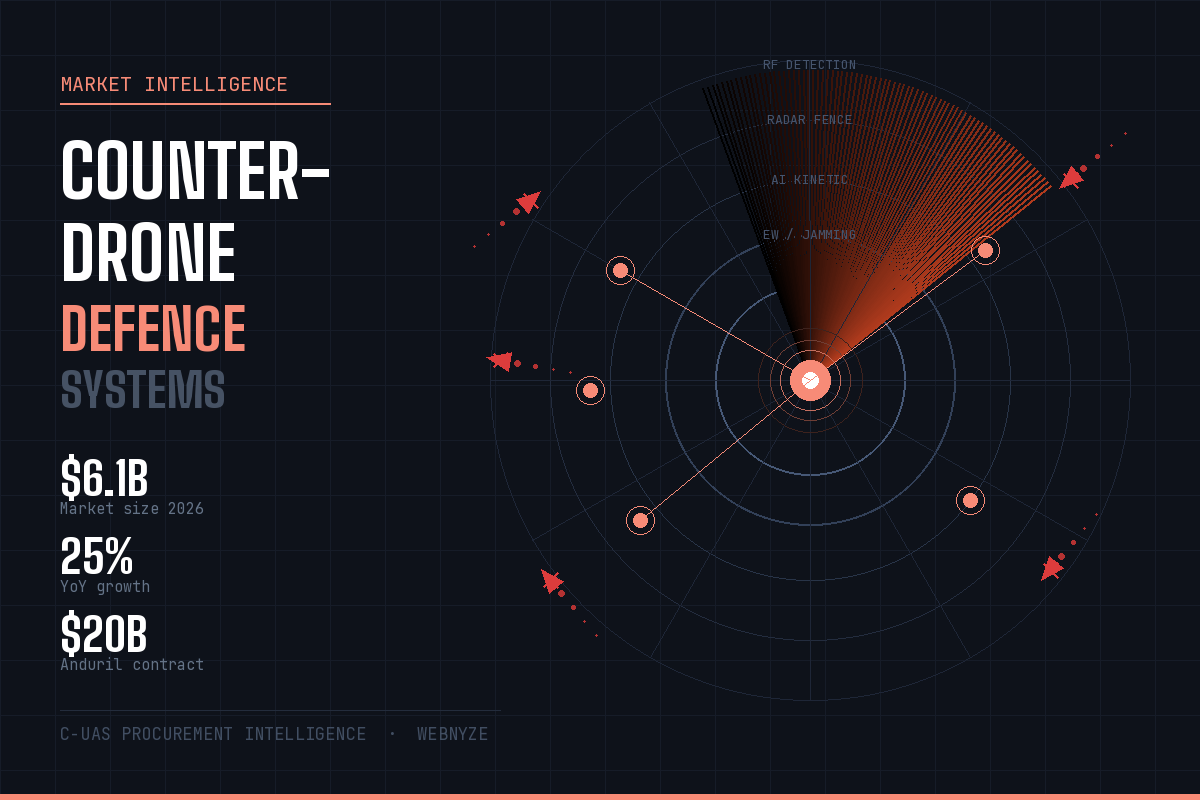
The counter-drone market isn't a trend anymore. It's infrastructure. The global market hit $6.1 billion in 2026, up 25% in a single year, and the trajectory toward $44 billion by 2035 is built on programmes that are already funded, already contracted, and already delivering.
For companies operating in this space — whether you build detection hardware, develop AI-enabled C2 software, supply effector systems, or advise on procurement — the challenge isn't finding opportunity. It's tracking the procurement signals fast enough to act on them before they become public knowledge. That's the gap this piece is about.
The counter-UAV market was valued at $4.9 billion in 2025. It grew to $6.125 billion in 2026 — nearly 25% in twelve months. By 2027, analysts project $7.6 billion. By 2035, $44.7 billion at a compounding rate of 24.7%. That kind of sustained growth is rare in any sector and almost unheard of in defence procurement, where cycles are long and budgets are sticky.
What's driving it isn't a single contract or a single event. It's the convergence of three things happening simultaneously: geopolitical proof that drone threats are real and immediate; legislative expansion of procurement authority to previously excluded buyers (state and local agencies in the US, non-military agencies in Europe); and institutional recognition that the current level of counter-drone capability is inadequate.
The anti-drone market specifically — looking at integrated neutralisation systems rather than detection-only products — sits at $3.74 billion in 2026 and is heading for $12.5 billion by 2032 at a 24.5% CAGR. The top ten players account for just 28% of market revenue, which tells you something important: this is a pre-consolidation market with a long tail of specialist firms competing on niche capabilities. That's a very different dynamic than the mature prime-dominated segments of broader defence.
The catalyst isn't a single event — it's an accumulation of events that finally broke through procurement inertia. Ukraine proved that cheap drones could change battlefield outcomes. The Middle East proved that state actors could weaponise commercial drone supply chains at scale. And a string of airspace violations over NATO's own territory proved that no one is immune.
In 2025, Russian drones penetrated airspace over Belgium, Germany, Denmark, and Norway — including overflights of NATO military bases and nuclear facilities. These weren't isolated navigation errors. They were deliberate probes of European air defence, and the response — scrambling multimillion-dollar fighter jets to intercept drones worth a few hundred dollars — demonstrated the asymmetry problem in the starkest possible terms. Belgium responded by establishing a permanent National Airspace Security Center operational by January 2026. The EU responded with EDDI. NATO responded with Project Flytrap, an ongoing exercise series testing counter-drone integration across land forces.
When Iran struck simultaneously across nine countries in February 2026, the strategic lesson was unmistakeable: drone swarm capability had reached a point where even allied nations far from any front line needed to think seriously about air defence. Bahrain, Kuwait, Qatar, Saudi Arabia, the UAE, Jordan, and a UK RAF base in Cyprus were all hit within hours of each other. Every defence ministry watching this drew the same conclusion: the current counter-drone posture is not sufficient.
Military-grade drones get most of the attention, but the fastest-growing threat vector is commercial. Around 58% of security organisations report increased unauthorised drone activity, and the threat isn't always state-sponsored: prison drone drops, airport disruptions, critical infrastructure surveillance, and VIP event intrusions are now routine concerns for law enforcement, airport operators, and event security teams. The Safer Skies Act in the US was specifically designed to address this — unlocking C-UAS authority and funding for state and local agencies that previously had no legal pathway to use counter-drone technology.
Russian drone overflights of Belgium, Germany, Denmark, and Norway in 2025 triggered emergency procurement reviews across NATO. The Nordic-Baltic corridor is now the primary driver of European C-UAS demand outside Ukraine.
DHS finalised $115M for FIFA-specific counter-drone coverage plus a separate $625M FEMA grant for 11 host states. This is the largest single event-driven C-UAS procurement in history, with procurement cycles already underway.
India placed fresh orders with domestic firms totalling $1.5 billion in counter-drone technologies, including a naval contract with Bharat Electronics Limited. This signals Asia-Pacific as the fastest-growing regional market at 30% CAGR through 2030.
A Shahed-class drone costs a few hundred dollars. The interceptors used to destroy it cost $100K–$3.9M. Every defence ministry is now prioritising low-cost kinetic and AI-autonomous defeat options to break this asymmetry.
Understanding the technology landscape matters if you're tracking procurement, because different technology layers have very different contract profiles, vendor landscapes, and procurement pathways. A detection sensor contract looks nothing like an AI-enabled kinetic defeat contract — and the firms winning one aren't necessarily positioned for the other.
Modern C-UAS architecture operates in three layers. All three are needed. None works reliably without the others. The C2 software layer that binds them together is increasingly where the competitive moat actually sits.
Identifies and tracks threats before any countermeasure is deployed. Detection technologies include:
Non-kinetic countermeasures that disable drones without physical destruction. Lower legal complexity than hard kill in most jurisdictions.
Kinetic countermeasures that physically destroy or capture the drone. Required when soft-kill fails or is legally unavailable.
The C2 software layer is where procurement is increasingly concentrating. Single-sensor, single-effector systems are being replaced by integrated platforms that fuse radar, RF, and EO/IR data, apply AI threat classification, and direct the most appropriate countermeasure — all without waiting for a human decision loop that may be too slow. Platforms like Dedrone's DedroneDefender, Hensoldt's modular C-UAS architecture, and SAPIENT's data integration standard are competing to become the operating system that everything else plugs into. That's an important dynamic for firms evaluating market entry: the hardware may be commoditising faster than expected, but the software intelligence layer has durable margin potential.
The US is the largest single market, accounting for approximately 41% of global C-UAS spending. What makes 2026 different from every previous year is the combination of legislative expansion (Safer Skies Act) with institutional proliferation (DoD, DHS, FEMA, and now SLTT agencies all buying simultaneously). The procurement pipeline is wider than at any point in the technology's history.
| Contractor / Recipient | Value | Awarding Agency | Programme / Purpose | Type |
|---|---|---|---|---|
| Trust Automation | $490M IDIQ | US Air Force | C-UAS development & fielding through 2030 | DoD |
| Multiple (Replicator 2) | $1.1B programme | DoD / DIU | Counter-small UAS; Fortem DroneHunter F700 first purchase | DoD |
| DHS Programme Exec. Office | $115M | DHS | FIFA World Cup 2026 & America250 event security C-UAS | DHS |
| 11 Host States (FEMA) | $625M | FEMA | FIFA World Cup drone detection & tracking systems | FEMA |
| SLTT Agencies (national) | $500M fund | FEMA | Safer Skies Act — drone detection for priority events, FY2026 | FEMA |
| MyDefence | $26M | US Army | 485 mobile C-UAV kits for Army Transformation-in-Contact units | DoD |
| DroneShield | $8.2M | Western military (undisclosed) | Handheld C-UAS systems, accessories, software updates | Allied |
| DroneShield | $6.2M | Asia-Pacific military (undisclosed) | C-UAS systems for APAC military deployment | Allied |
| Raytheon / Tawazun (UAE) | Undisclosed | UAE Defence | Joint production of Coyote counter-UAS interceptor systems | Middle East |
| Bharat Electronics Ltd (India) | Part of $1.5B | Indian Navy | Domestic naval counter-drone system — laser-based kill mechanism | APAC |
| Thales / CS Group (France) | $32.85M | DGA (French Defence) | PARADE drone countermeasures programme | Europe |
| CBP / ICE (open) | $1.5B vehicle | DHS / CBP & ICE | Proposal solicitation phase — border counter-drone platform | DHS |
The CBP and ICE $1.5 billion contract vehicle is worth particular attention for anyone in this space. It's currently in the proposal solicitation phase — which means the window to position is right now, not after award. The same applies to several EDIP calls under the European Drone Defence Initiative that are accepting consortium applications ahead of formal Q4 2026 deployment deadlines.
On 11 February 2026, the European Commission published its Action Plan on Drone and Counter-Drone Security. The document isn't a research paper — it's an operational blueprint. It establishes coordinated actions across member states, defines EDDI as the flagship procurement programme, and sets explicit deadlines tied to SAFE loan drawdowns and European Defence Fund calls.
What EDDI is building is a distributed, software-centric airspace defence system — described by some analysts as a "drone wall" — designed to detect, track, and neutralise hostile UAVs across Europe. The architecture is deliberately modular: standards for sensors, jammers, and data-fusion software are being developed in cooperation with CEN-CENELEC and NATO working groups, precisely so that national systems from different vendors can interoperate.
The practical implications for suppliers are significant. EU-funded programmes under EDDI require interoperability standards compliance — systems that can't communicate with a NATO SAPIENT-compatible C2 platform won't qualify. Many programmes also require multi-nation consortium structures, which means companies entering through EDIP calls need established relationships with partners in other member states before the formal solicitation is published.
The Nordic-Baltic corridor is the most time-sensitive procurement geography within EDDI. Estonia, Latvia, Lithuania, Finland, Denmark, and Norway are all accelerating C-UAS programmes, primarily in response to direct Russian airspace violations. The Eastern Flank Watch component of NATO's Readiness Roadmap — closely tied to EDDI — is expected to generate the largest single tranche of European counter-drone contracts in the second half of 2026.
The C-UAS competitive landscape is bifurcating. On one side, defence primes with integrated systems. On the other, specialist pure-plays competing on specific capability niches. The market is pre-consolidation — fragmented enough that smart positioning now can create durable advantage.
Among the primes, Lockheed Martin leads with approximately 4% market share through its Rotary and Mission Systems division. RTX's Coyote interceptor system has become a marquee product for swarm defeat — the UAE joint production deal signals international licensing appetite. Thales dominates the European integrated systems space, with the PARADE programme in France and significant EDDI positioning. Northrop Grumman and SAAB are the other major integrated system providers.
Among pure-plays, DroneShield (ASX-listed, headquartered in Australia) has been the most active contract winner in early 2026 — two contracts totalling $14.4 million across Western and Asia-Pacific military customers in the first month of the year alone. Dedrone brings an AI-first detection and tracking software layer that works across multiple hardware vendors. Fortem Technologies' DroneHunter F700 was the first system selected under the DoD's Replicator 2 initiative, giving it a significant procurement reference point for follow-on international sales.
The emerging track to watch most closely is AI-autonomous kinetic defeat — systems where an AI decides to engage and execute without a human in the loop. This market is worth $600 million now and projected to hit $2.7 billion by 2030. The combat validation data coming out of Ukraine is the most important procurement signal in this subsegment: one AI-enabled kinetic system has logged nearly 2,000 confirmed kills, which is the kind of operational record that compresses procurement decision timelines dramatically.
The counter-drone contract landscape is genuinely chaotic to monitor. DoD contracts flow through SAM.gov. FEMA grants have their own portal and application cycle. DHS's new Programme Executive Office makes announcements through press releases and industry days. EDDI calls live inside the European Commission's funding portal. NATO agency contracts appear on NCIA and NSPA supplier portals. Bilateral contracts — like the UAE-Raytheon Coyote production deal or India's BEL naval contract — surface through company press releases and defence press, days or weeks after the actual award decision.
If you're relying on any single source — even a good one — you're missing most of the picture. Here's what it looks like when companies close that gap:
Webnyze aggregates counter-drone contract awards, solicitations, and programme announcements from SAM.gov, FEMA grant portals, DHS programme announcements, NCIA and NSPA, TED EU, 40+ national procurement portals, and defence news monitoring — structured into a single queryable dataset with programme type, contract vehicle, value, awarding agency, and deadline dates. When DHS published the $115 million FIFA World Cup C-UAS solicitation, clients tracking DHS counter-drone keyword profiles had the structured data the same day. When the $1.5 billion CBP/ICE vehicle entered proposal phase, it was flagged immediately with the relevant programme office contact details and competitive history.
In counter-drone procurement, the gap between contract award and public announcement can be weeks or months. Webnyze cross-references company press releases, investor filings, programme office announcements, and defence trade press to build a real-time picture of which vendors are winning which technology categories. When DroneShield posted its January 2026 contract wins to the ASX before any DoD announcement, clients tracking DroneShield's programme portfolio had the intelligence immediately. When Fortem's DroneHunter was selected for Replicator 2, it surfaced as a lead in our defence news monitoring before the formal contract notice appeared on SAM.gov.
Two of the largest procurement mechanisms in 2026 — the EU's EDDI-linked EDIP calls and the US FEMA Safer Skies grant programme — have very different timelines, eligibility criteria, and consortium requirements. Webnyze monitors European Commission funding portal pre-announcements, EDIP work programme updates, and FEMA Notice of Funding Opportunity releases to give clients early visibility. For the FEMA programme, Webnyze tracks which jurisdictions are likely to apply and what systems are on their evaluated vendor lists — information that typically surfaces through local government procurement notices months before formal award decisions.
Counter-drone procurement decisions are concentrated in a relatively small number of programme offices — DHS's PEO-UAS, the DoD's Joint C-sUAS Office (JCO), EUCOM's force protection teams, and national equivalents across NATO. Webnyze tracks senior personnel movements, public statements, industry day participation, and procurement office appointments across these organisations. For a firm positioning into the CBP/ICE border C-UAS contract, knowing who moved from the JCO to DHS and when is worth considerably more than reading the public solicitation. These transitions happen 6–12 months before formal requirements are published.
The fastest path to a funded counter-drone programme in 2026 is combat validation data. Every procurement officer in Europe and the US is looking at what's been proven in Ukraine and the Middle East before committing budget. Companies that track which systems are logging field deployments — and in which operational conditions — have a significant advantage in shaping requirements before the formal solicitation is written. Knowing that a competitor's system has 2,000 documented kills in GPS-denied contested airspace changes how you write your own capability statement.
European EDDI-linked programmes require multi-nation consortium structures, interoperability standards compliance, and often specific national industrial content requirements. Companies that have already mapped the European C-UAS SME landscape — which firms hold what certifications, which already have NATO agency relationships, which have demonstrated SAPIENT-compatible architectures — can build teaming structures before a formal call opens. The companies that won early EDF grants in the drone space built those relationships 12–18 months before formal solicitation. The EDDI timeline is too tight to build them after.
The counter-drone market is attracting significant VC and PE attention, and valuations in this space are rising quickly. Investors are using contract intelligence to validate what companies claim in pitch decks — confirmed contract awards, programme office relationships, evaluation status on specific procurement vehicles. The gap between "we're in advanced discussions with multiple NATO allies" and "here are two verified contract notices on NCIA's portal" is significant, and finding it before term sheet is exactly the kind of diligence that structured procurement data makes possible.
The FIFA World Cup and America250 events represent the largest civilian C-UAS deployment in history. For firms that haven't yet broken into government procurement, these contracts — funded through FEMA and DHS with faster acquisition timelines than standard DoD programmes — are a meaningful entry point. Companies that win FIFA deployments get operational references, performance data in a high-visibility environment, and procurement relationships with agencies that will be spending on counter-drone capability long after the tournament ends. The FEMA grant application cycles for host states are already underway.
The CBP/ICE $1.5 billion vehicle is the largest single unawarded C-UAS contract on the market. Currently in proposal solicitation phase, this is a border counter-drone platform that will define the commercial landscape for handheld, vehicle-mounted, and fixed-site systems across US border security. The firms that win positions on this vehicle will have reference contracts that open doors across dozens of allied nation procurements. It deserves close monitoring.
EDDI's Q4 2026 initial capacity deadline is creating emergency procurement urgency. The Nordic-Baltic corridor is the most active sub-market within EDDI right now, with Estonia, Latvia, Lithuania, and Finland all accelerating programmes that combine detection networks and soft-kill effectors. These are small-country procurement offices with limited bandwidth — firms that engage through DIANA or directly with national procurement offices now are better positioned than those who wait for formal EDIP publication.
AI-autonomous kinetic defeat is the fastest-moving subsegment. The cost-per-engagement economics are compelling: AI-enabled kinetic systems run $10,000–$15,000 per engagement versus $100,000–$3.9 million for traditional interceptor missiles. Every major western military is now evaluating autonomous kinetic defeat in parallel with directed energy. The firms leading this space — primarily startups rather than primes — are accumulating contract references quickly. Tracking who's winning evaluation programmes across NATO armies is the most important competitive intelligence task in this segment right now.
M&A is coming. The market is pre-consolidation, the primes have acquisition budget, and several pure-play counter-drone firms now have operational reference data that makes them attractive targets. Tracking which specialist firms are winning concentrated contracts with strategic customers — the kind of customer relationships that a prime would value — is the leading indicator for acquisition targets 12–24 months before a deal happens.
The counter-drone market has a particular characteristic that makes procurement intelligence especially valuable right now: it's fast-moving, pre-consolidation, and politically urgent. Governments are spending at a pace they haven't justified through committee review cycles. Contracts are being awarded on shorter timelines than anyone expected. Technology that spent years in demonstration mode is being deployed operationally almost overnight.
In that environment, information speed is the competitive advantage. The firms winning the most interesting positions in this market right now aren't necessarily the best-funded or the longest-established. They're the ones who knew about the CBP/ICE solicitation before the industry day announcement. Who had relationships with Nordic procurement offices before the EDDI calls were published. Who tracked the Replicator 2 programme from DIU's early-stage market research phase rather than scrambling when the formal solicitation appeared.
At Webnyze, we build that kind of intelligence infrastructure — aggregating counter-drone contract signals from 40+ procurement portals, tracking technology track winners through press releases and filings, monitoring decision-maker movements across defence agencies and prime contractors, and delivering structured, queryable data that gives BD teams the same visibility that was previously available only to the most well-connected firms in the industry.
Request a free sample dataset covering C-UAS contract awards, technology track winners, FEMA grant recipients, and EDDI procurement signals — or talk to us about a custom monitoring solution built around your target programmes and geographies.
Tell us what you need to scrape. We'll deliver a free sample dataset within 48 hours — no commitment, no credit card.