For most of the past decade, "European defence procurement" was a story about underspending, fragmentation, and unfulfilled commitments. That story is over. What's replaced it is something the continent hasn't seen since the Cold War — a coordinated, funded, multi-year rearmament programme with real money behind it and real urgency driving it.
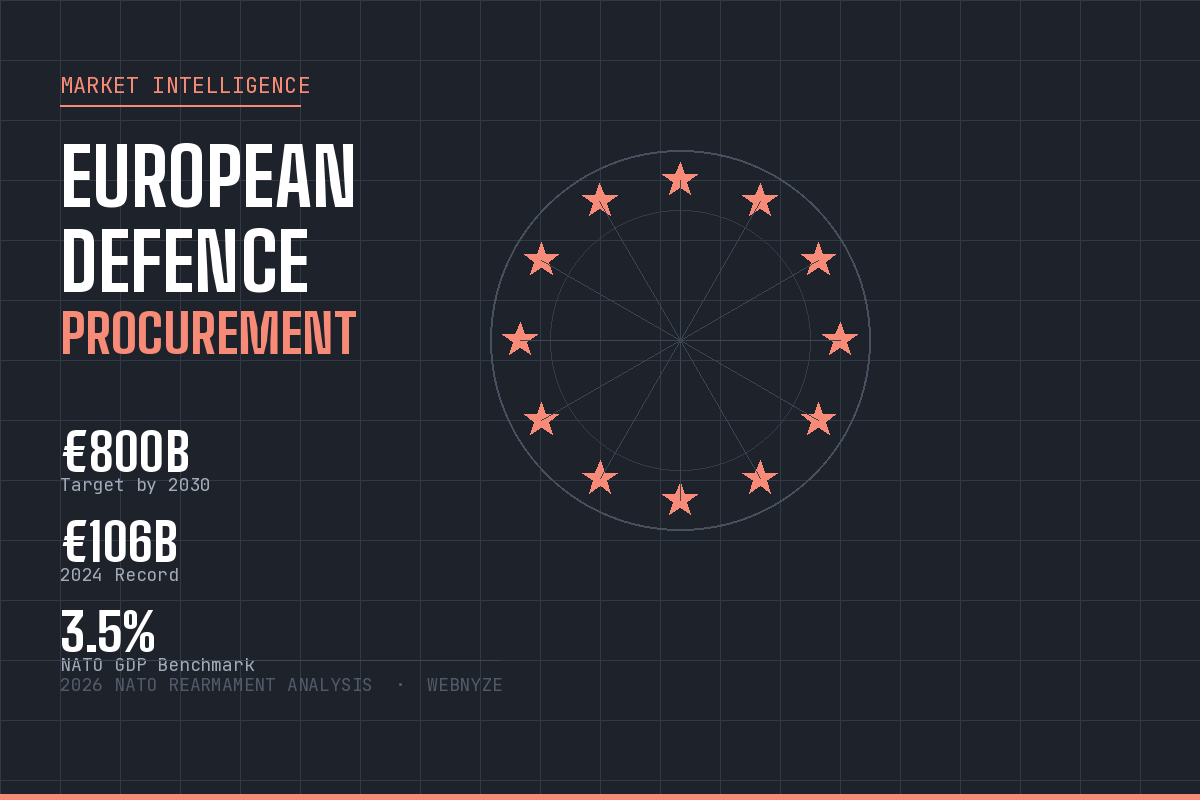
At the 2025 NATO Summit in The Hague, member states agreed to raise the collective spending benchmark to 3.5% of GDP by 2035. That's not a suggestion. It's a target backed by €800 billion in projected spending, €150 billion in SAFE loans fully subscribed by 19 member states, and a Defence Readiness Roadmap that reads like a procurement calendar rather than a policy document. Germany alone has 154 major defence purchases planned through 2026. Poland is already spending 4.7% of GDP — the highest rate in NATO. EU defence investment broke the €100 billion threshold for the first time in 2024 and it's heading toward €130 billion in 2025.
For companies selling into this market — contractors, integrators, technology suppliers, data firms — the opportunity is genuinely generational. But the procurement landscape is also one of the most complex in the world. Tenders are scattered across dozens of national portals, NATO agency databases, EU frameworks, and bilateral programme offices. The companies that win are the ones who see the signals first.
That's what this piece is about. We'll walk through exactly what's happening in European defence procurement right now, which programmes are most active, where the spending is concentrating, and how companies are using structured intelligence data to position themselves ahead of where the contracts are going — not just where they've been.
It helps to understand exactly how fast things have moved. European NATO members more than doubled their weapons imports between 2020 and 2024 — and 64% of that went to US suppliers. That ratio is now actively being reversed. The EU's target is that 55% of all weapons purchases come from European or Ukrainian manufacturers by 2030. That's not just a political statement. It's a structural demand signal for European industrial capacity.
The EDA data makes the shift concrete. EU member state defence expenditure reached €392 billion in 2025 — crossing 2% of GDP as a bloc average for the first time. Defence investment specifically (equipment procurement plus R&D) hit €106 billion in 2024 and is projected to approach €130 billion in 2025. Since 2022, the equally-weighted index of large, publicly-listed European defence companies has delivered a total shareholder return of 401% — outperforming both broader equity indices and their US peers by a wide margin.
What makes this moment different from previous NATO spending pledges is that the money is already moving. The €150 billion SAFE instrument was fully subscribed. The EDF (European Defence Fund) is active with €8 billion committed across the 2021–2027 budget cycle. And crucially, the pace of equipment orders has accelerated ahead of actual deliveries — which means the backlog of contracted but undelivered capability is itself a procurement signal for sustainment, spares, and follow-on programmes.
What makes the current moment different from every previous European defence spending pledge is that this time there's a mechanism — not just a target. The Defence Readiness Roadmap 2030, launched in early 2026, isn't aspirational language. It is, as one analyst put it, an institutional mechanism for converting strategic intent into procurement-relevant commitments that can be monitored, financed, and tracked against observable milestones.
Each flagship initiative under the Roadmap has a launch date, an initial capacity target, and an explicit link to EDIP calls and SAFE pre-financing from Q1 2026. The 40% joint procurement threshold must be reached by 2027. These aren't soft targets. The Roadmap's own monitoring standards are what they're measured against, and member states that fall short face structured review processes.
What this produces, practically speaking, is a forward-looking procurement calendar that is more legible than at any point in the last two decades. The challenge is that it's still spread across dozens of sources — which is where intelligence infrastructure becomes the differentiator between firms that position early and firms that react late.
The Readiness 2030 framework centres on four flagship initiatives. Each is a direct procurement signal — not just for prime contractors, but for the whole supply chain beneath them, and for any firm tracking competitive positioning across the market.
The single most time-sensitive programme in the Roadmap. EDDI is designed to give Europe a coordinated counter-drone and drone strike capability — something that was conspicuously absent as Russian UAVs violated Belgian, German, Danish, and Norwegian airspace in late 2025. The initial capacity target is end of 2026. Full functionality by end of 2027. The programme is linked directly to SAFE loan drawdowns and EDF calls already open. For any company in the C-UAS, drone hardware, or battlefield AI space, this is the most active procurement window in Europe right now.
This programme fortifies Europe's borders with Russia through ground defence, air defence, and border management systems. Functional target is end of 2028. The scope is deliberately broad — from anti-tank systems to drone surveillance to communications infrastructure. The lead nations are the Baltic states and Poland, with co-procurement structures being designed to reduce per-unit costs for all participating countries.
Integrated air and missile defence across the continent. This is where the interceptor depletion problem from Ukraine and the 2026 Middle East conflict becomes a direct procurement driver. Countries that burned through Patriot interceptors, IRIS-T batteries, and Stinger inventories need to replenish — and they're doing it through multilateral programmes, not just national orders, to keep costs manageable and delivery timelines credible.
Satellite-based intelligence, communications, and domain awareness. This is the programme most directly linked to Space Force-adjacent procurement — monitoring constellations, secure communication satellites, and the ground infrastructure that ties it together. York Space's $187 million commercial satellite contract and AST SpaceMobile's Space Development Agency agreement in early 2026 are both indicators of where the money is flowing at the capability layer.
The most immediate procurement window. EDIP calls and SAFE pre-financing are already open. Companies in C-UAS, loitering munitions, and battlefield AI should be in this now, not watching from the sidelines.
Only 18% of EU equipment spending is currently collaborative. Hitting 40% by 2027 requires a step-change in multi-nation programme structure. Every consortium formation is a competitive intelligence event worth tracking.
The Defence Readiness Omnibus estimates €42.5–51.3B in NPV benefits from regulatory simplification alone. 60-day permitting regimes, REACH exemptions for defence materials, and finance access changes reduce the cost of doing business meaningfully.
European defence VC investment roughly doubled to tripled in 2025. Firms tracking which European startups are gaining funding — and from which investors — have a head start on identifying the next tier of procurement-relevant players before they reach the prime level.
The SAFE instrument is the financial engine behind much of Readiness 2030. €150 billion in loans, fully subscribed by 19 member states. But there are conditions that significantly affect who benefits from the money.
To access SAFE funds, procurement must favour European or Ukrainian manufacturers. The German procurement plan makes this concrete: 154 major defence purchases planned through 2026, with only 8% going to US suppliers — a sharp reversal from recent years when Germany was one of Washington's biggest defence buyers. French officials have declined to channel funding through NATO's Ukraine support mechanisms that flow to American weapons. The message is consistent: European money should build European industrial capacity.
For suppliers, this creates two very different situations. European manufacturers and integrators are looking at a multi-year demand signal that is unprecedented in modern peacetime. Non-European suppliers — unless they have European manufacturing subsidiaries, joint venture structures, or specific interoperability agreements — face real access constraints that weren't there before. Tracking which procurement vehicles require European content, and which are open to allied suppliers, is a significant intelligence task on its own.
The collaborative procurement story is also one to watch closely. Currently around 18% of EU equipment spending is collaborative (against a 35% benchmark agreed in 2007, still unmet). The Readiness 2030 target pushes this to 40% by 2027. Getting from 18% to 40% in under two years requires a significant acceleration in consortium formation, joint programme offices, and shared requirements development — all of which produce trackable procurement signals well before formal tenders are issued.
One of the structural challenges in European defence procurement is the sheer fragmentation of where contracts actually get published. Unlike the US DoD's relatively centralised SAM.gov, European defence procurement runs across a patchwork of national systems, EU-level portals, NATO agency databases, and bilateral programme offices — each with different formats, languages, search functionality, and update cadences.
| Portal / Source | Scope | Estimated Annual Tenders | Language | Type |
|---|---|---|---|---|
| TED (Tenders Electronic Daily) | All EU member states above threshold | 12,000–18,000 | 24 languages | Primary |
| BAAINBw (Germany) | Bundeswehr acquisition — all major German procurement | 1,800–2,400 | German | National |
| Contracts Finder (UK) | UK MoD and defence primes above £12,000 | 2,000–3,000 | English | National |
| NCIA / NSPA (NATO) | NATO agency contracts — communications, logistics, infrastructure | 600–900 | English | NATO |
| DEMIL / DGA (France) | Direction Générale de l'Armement — French military procurement | 900–1,200 | French | National |
| Doffin (Norway) | Norwegian government procurement including defence | 400–600 | Norwegian | National |
| EDF Funding Portal | European Defence Fund grants for R&D and capability development | 40–80 calls | English | EU Grant |
| EDIP / SAFE (emerging) | New joint procurement instrument — 2026 onwards | Growing | English | EU Loan |
Monitoring these manually is close to impossible at any meaningful scale. A procurement team focused on German opportunities alone would need to track BAAINBw, TED filtered by Germany, the Bundeswehr's framework contract award notices, and the EDF calls that have a German co-beneficiary — across multiple search interfaces, in German, with inconsistent update timing. Scale that across five target markets and the challenge becomes structural, not operational.
The European defence market has historically been dominated by a small number of established primes — Airbus Defence and Space, Thales, BAE Systems, Leonardo, Rheinmetall, MBDA — and a long tail of national champions with limited cross-border reach. That structure is changing, but more slowly than the headlines suggest.
The EDA data makes the fragmentation concrete: over 80% of EU member state defence procurement goes to the top ten companies, with typically less than 30% of total order volume flowing to other firms. Europe operates a highly fragmented platform set — fragmentation levels more than four times higher than the United States — and that fragmentation has actually increased by close to 10% since 2014, driven mainly by land systems and missiles. More countries, more variants, more sustainment contracts, more opportunity for suppliers who can track the whole picture.
What's changing the game for smaller and non-traditional suppliers is the reform agenda within Readiness 2030 itself. The Defence Readiness Omnibus — still being implemented — targets a 60-day permitting regime with implicit granting, procurement threshold changes to lower barriers for SMEs, and a Commission Notice clarifying that EU sustainable finance rules impose no sectoral financing prohibition on defence. That last point matters more than it sounds: it had been used by some lenders to decline defence project finance on ESG grounds.
NATO's DIANA programme and the NATO Innovation Fund are creating direct routes for tech-driven SMEs into procurement. For companies operating in dual-use technology — AI, data analytics, cyber, communications — these pathways represent a genuinely new entry point that didn't exist two years ago.
The opportunity in European defence is real and it's substantial. The problem is that the intelligence infrastructure most companies are working with — alerts, manual portal checks, quarterly analyst reports — is not built for the speed or the complexity of what's happening right now. Procurement signals are buried in portals published in languages your team doesn't read. Contract awards happen faster than press releases follow. The executives who moved from a ministry to a prime contractor last quarter are already shaping requirements for programmes that won't be publicly tendered for six months.
Here's what it looks like when teams close that gap with structured data intelligence:
Webnyze aggregates and structures procurement announcements from TED, BAAINBw, Contracts Finder, Doffin, NCIA, and a further 40+ national and NATO portals into a single, queryable dataset. Contract values, awarding agencies, CPV codes, deadline dates, and eligible supplier criteria are extracted and normalised across languages. When a German Bundeswehr framework contract for autonomous ground systems is published on BAAINBw on a Tuesday morning, a client's BD team has it structured and tagged by Tuesday afternoon — without anyone having searched for it.
Defence contract awards often appear as news before they appear in official portals — in trade press, in company press releases, in filings. Webnyze monitors all of these simultaneously, cross-referencing award data against company profiles, contract history, and teaming partner lists. A client tracking Rheinmetall's growing footprint in Eastern European markets can see every contract win, JV announcement, and framework agreement as they happen — not three months later when a quarterly report summarises them.
European defence procurement decisions are made by programme managers, ministry officials, and requirements officers — many of whom move between public and private sector roles. Webnyze tracks senior executive movements, government-to-industry transitions, and board-level changes across the European defence ecosystem. For a company positioning into the EDDI programme, knowing which officials from the EDA have joined Airbus or Thales in the past twelve months — and therefore which firms have the clearest inside track on requirements — is worth more than any public document.
The European Defence Fund and the emerging SAFE instrument publish calls, pre-announcements, and work programmes on a rolling basis. Webnyze monitors EDF Funding Portal updates, Commission announcements, and the European Parliament's defence budget proceedings to give clients early visibility into call themes and eligibility criteria — typically weeks before formal publication. For companies that need multi-nation consortium partners to apply, that head start is often the difference between a credible bid and a scrambled one.
Data doesn't win contracts. How you use it does. These are the four ways teams across the European defence market are turning procurement intelligence into competitive advantage right now:
Many EDF and SAFE-funded programmes require multi-nation consortia. Companies that have already mapped the European SME landscape — who's raised funding, who has existing relationships with which ministries, who has relevant technical certifications — can build teaming structures before a call opens, rather than scrambling to find partners after the deadline is announced. The difference is often six months of relationship-building that either happens before a formal process or doesn't happen at all.
European defence startups are raising at higher valuations than ever. Investors are using contract intelligence to cross-reference what a company claims in its pitch deck against what's actually visible in public procurement records — framework agreements, subcontract awards, pilot programme notices. The gap between "we work with multiple European ministries" and "here are the actual award notices" is often significant, and finding it before a term sheet is signed is exactly the kind of diligence that structured data makes possible.
Companies entering European defence markets for the first time often underestimate how much the access question varies by programme type. SAFE-funded procurement has explicit European content requirements. NATO agency contracts (NCIA, NSPA) are more open to allied suppliers but have their own qualification and security requirements. EDF grants require multi-nation teams from EU member states. Mapping which vehicles are accessible given your company's nationality, subsidiaries, and existing certifications is a prerequisite to building a pipeline — and it's not obvious from reading the headline spending numbers.
The best time to start a conversation with a ministry programme manager is before they've finished writing the requirements. The second best time is right when a programme shifts from concept phase to formal procurement planning. Tracking the personnel movements, public statements, conference participations, and procurement office appointments that signal these inflection points — and building relationships at that moment rather than at RFP release — is how the companies with outsized win rates operate. It's not a secret. It's just information that most firms aren't collecting systematically.
The procurement calendar is dense for the remainder of the year. These are the developments we think will matter most:
EDDI initial capacity deadline — Q4 2026. This is the hardest deadline in the Readiness 2030 framework and the one with the most active procurement attached to it right now. Companies not already engaged in EDIP calls and SAFE pre-financing discussions are running short on lead time. The EDA's quarterly monitoring reports will signal which capability coalitions are on track and which are slipping — and slippage usually means emergency procurement, which is a different kind of opportunity.
Germany's procurement acceleration. With 154 major purchases planned for 2026 and a coalition government that put defence spending at the top of its agenda, Germany's BAAINBw is running the most active national procurement programme in Europe. The frameworks being put in place now — particularly in autonomous systems, communications, and air defence — will govern subcontracting patterns for years. Getting on the right frameworks in 2026 matters more than individual contract wins.
The M&A consolidation wave. European defence tech VC deal volumes rose 2–3× year-on-year in 2025. That level of startup formation, at that valuation level, historically produces a consolidation wave two to three years later. The primes that use 2026 to map and engage the most capable European startups — before they become acquisition targets or get absorbed by competitors — will be better positioned for the next capability cycle. The window between "interesting startup" and "already acquired" is getting shorter.
The APAC overspill effect. European contractors and their industrial partners are increasingly being invited into programmes in the Indo-Pacific — particularly with Australia (AUKUS-adjacent), Japan, and South Korea. Tracking which European firms are winning framework positions in these markets, and what technology categories are transferring, is a useful signal for where European defence industrial capacity is heading next. The companies building dual-use export profiles in parallel with their European domestic push are the ones to watch.
European defence procurement is in the middle of a structural shift that will run for the rest of this decade. The money is real, the programmes are active, and the timelines are tighter than any comparable peacetime rearmament effort. Companies that move with the cycle — that have visibility into which tenders are opening, which consortia are forming, which executives are shaping requirements — will accumulate positions that compound over time. Companies that move reactively will chase contracts that were effectively decided six months earlier.
The complexity of the European procurement landscape isn't going away. If anything, it's increasing as new instruments like SAFE and EDIP layer on top of existing national and NATO frameworks. That complexity is the moat for firms that invest in intelligence infrastructure early. It's also the wall that keeps well-resourced competitors from moving as fast as they otherwise could.
At Webnyze, we build that intelligence infrastructure — aggregating procurement signals from 40+ European portals, tracking decision-maker movements across the defence ecosystem, and delivering structured, queryable data that gives BD, strategy, and investment teams the same visibility into European procurement that most firms only get after the fact. If European defence is a market you're positioning into this year, that's what we should be talking about.
Request a free sample dataset covering EU and NATO tender awards, European defence contractor profiles, and live contract signals — or talk to us about a custom monitoring solution built around your target markets and programmes.
Tell us what you need to scrape. We'll deliver a free sample dataset within 48 hours — no commitment, no credit card.