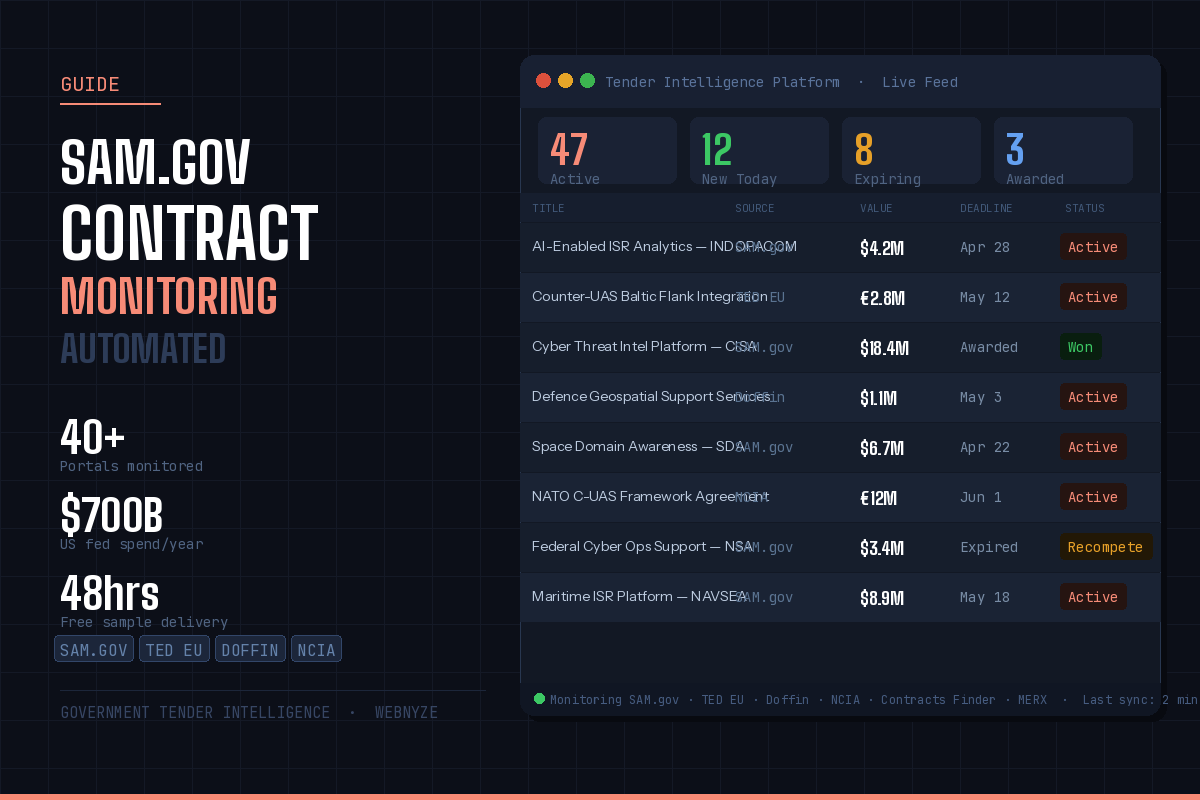
Here is a situation that will be familiar to anyone working BD at a government contractor: it's Tuesday morning, you run your usual SAM.gov search, and you find a solicitation that closed on Friday. The opportunity was squarely in your wheelhouse - the right NAICS code, the right agency, exactly the kind of contract you have past performance on. You missed it by three days because the alert you set up last quarter uses keywords that didn't match the contracting officer's specific phrasing.
This happens constantly. And it's not a problem of effort - BD teams are checking SAM.gov daily. It's a structural problem. SAM.gov's native search and alert system was built for compliance, not for competitive intelligence. It covers one portal out of the dozens that matter, its keyword matching is brittle, it shows you nothing about what your competitors are winning, and it requires manual checking to catch the contracts that slip through the cracks.
For a company whose pipeline depends on government contracts, missing relevant tenders is not a minor inconvenience. It's revenue that walks out the door silently. The fix is not working harder on SAM.gov - it's building the infrastructure to monitor SAM.gov and every other relevant procurement portal automatically, with structured data that your BD team can actually act on.
This guide covers exactly how to do that: what portals need monitoring, what data to extract, how to structure it for your team, and where Webnyze fits in for companies who want this done for them rather than built from scratch.
SAM.gov is essential. It is the primary source for US federal contract opportunities, and any company selling to the federal government needs to be active on it. But it has three structural limitations that create real gaps in any BD intelligence process.
SAM.gov covers US federal contracts. It does not cover state and local government (a market worth hundreds of billions annually), NATO and European defence contracts, UK Ministry of Defence, Canadian MERX procurement, or any of the 30+ additional portals that matter for contractors with international or multi-jurisdictional remits. If 40% of your target agencies publish outside SAM.gov, monitoring SAM.gov exclusively means missing 40% of your pipeline.
A properly configured multi-portal monitoring system ingests SAM.gov alongside TED EU (700,000+ annual notices), Contracts Finder UK, Doffin Norway, NCIA and NSPA NATO portals, and 30+ additional sources. Every relevant tender, regardless of where it's published, arrives in a single feed - structured, classified by category, and ready for your team to evaluate.
SAM.gov's native alerts match on the exact keywords you set. If you're monitoring "cybersecurity services" but the solicitation is titled "information assurance support," your alert doesn't fire. Contracting officers use inconsistent terminology. NAICS codes are often mislabelled. Pre-solicitation notices use different language than the final RFP. Keyword-only monitoring consistently misses 20–30% of relevant opportunities.
Structured monitoring using NAICS codes as the primary filter, combined with broad keyword matching across title, description, and statement of work text, dramatically reduces missed opportunities. Adding PSC (Product Service Code) filtering on top of NAICS gives a second classification layer that catches contracts labelled under adjacent codes.
SAM.gov shows you opportunities - but its award data is harder to work with. Knowing who is winning contracts in your target categories, at what prices, and on what vehicle types is essential intelligence for competitive positioning and re-compete targeting. Most BD teams have no systematic way to track this, leaving them to price proposals based on guesswork rather than actual market data.
Structured award monitoring tracks who is winning contracts in your target NAICS categories, identifies re-compete opportunities as contracts approach expiry, and builds a competitive pricing database from historical award values. In February 2026, SAM.gov absorbed FPDS.gov's ezSearch - making awards data more accessible, but still requiring systematic extraction to be useful at scale.
The procurement landscape that matters for most government contractors extends well beyond SAM.gov. Here is a practical map of the portals that are worth monitoring and what each one covers.
| Portal | Scope | Annual Volume | Key for | Type |
|---|---|---|---|---|
| SAM.gov | US federal - all agencies, all departments | 60,000–90,000 opportunities | All US GovCon | Primary US |
| TED (EU) | All 27 EU member states above threshold | 700,000–800,000 notices | European contracts | Primary EU |
| Find a Tender (UK) | All UK public contracts above threshold | 2,000–3,500 per month | UK MoD, NHS, councils | UK National |
| Doffin (Norway) | Norwegian public procurement | 400–600 per month | Norwegian defence, energy | Nordics |
| BAAINBw (Germany) | Bundeswehr acquisition - all major German military | 1,800–2,400 per year | German defence | EU National |
| NCIA / NSPA (NATO) | NATO agency contracts - comms, logistics, infrastructure | 600–900 per year | NATO defence suppliers | NATO |
| MERX (Canada) | Canadian federal and provincial procurement | 1,500–2,500 per month | Canada federal, defence | Americas |
| USASpending.gov | US federal awards data - all contract actions | Millions of records | Award tracking, competitor intel | US Awards |
The practical challenge is that each of these portals has a different data format, update cadence, search interface, and level of machine-readability. TED publishes in 24 languages. BAAINBw publishes in German. Doffin in Norwegian. NCIA contracts often require account registration to access full details. Building manual monitoring workflows across even five of these portals is a significant operational overhead - and it still doesn't give you the structured, normalised dataset you need to work efficiently across them.
Not all procurement data is equally valuable. The fields that matter most for a BD team are different from the fields that matter for a compliance analyst or a market researcher. Here is what a properly structured contract monitoring feed should deliver.
The most overlooked field is the incumbent contractor. On re-compete solicitations, knowing who currently holds the contract is essential context - it affects your pricing strategy, your technical approach, and your probability of win assessment. SAM.gov often includes this in the description or in attached documents, but it requires extraction and normalisation to be useful in a structured feed. Webnyze includes incumbent data where available as standard.
Contract vehicle type is the second most overlooked field. A solicitation issued under an IDIQ vehicle like GSA OASIS or SEWP has very different competitive dynamics than a standalone full-and-open competition. If your company is not on the relevant IDIQ vehicle, you may not be eligible to compete - and finding that out after an hour of proposal analysis is wasted time. Filtering by eligible vehicle type before your team reviews an opportunity is a basic efficiency gain that structured monitoring enables.
Procurement data in its raw form - PDFs on government portals, XML feeds with inconsistent schema, HTML tables in different languages - is not useful to a BD team. The value of structured monitoring is in the normalisation: taking all of that heterogeneous source material and delivering it in a consistent, queryable format. Here is what a Webnyze government tender record looks like.
Tell us your target NAICS codes, agencies, or keywords. We'll pull 50 current opportunities and award records and send them within 48 hours. No meeting required.
Most BD teams monitor solicitations - the open opportunities they can bid on. Far fewer systematically track contract awards. That's leaving the most actionable competitive intelligence on the table.
Award data tells you three things that solicitation data cannot. First, who is winning contracts in your target categories. If the same five companies are consistently winning NAICS 541511 contracts at INDOPACOM, that's a competitive landscape you need to understand before you price your next proposal. Second, at what prices contracts are being won. The award value relative to the estimated value tells you whether the competition was tight or whether there was headroom. Third, when existing contracts are expiring - and therefore when re-compete solicitations will appear.
The re-compete signal is particularly valuable. A contract awarded to a competitor in your NAICS category, with a one-year base and three one-year options, will likely enter a new procurement process approximately 12 months before expiry. If you're monitoring award records, you see that opportunity 18 months before it appears as a new solicitation on SAM.gov. If you're not monitoring award records, you're competing with companies who had 18 months of preparation time.
In February 2026, SAM.gov absorbed the FPDS.gov ezSearch functionality, making awards data available in the same interface as opportunities for the first time. That's a positive development, but the data is still in a raw, unstructured format that requires extraction and normalisation to be useful in a BD workflow. The improvement in data access makes systematic award monitoring more important to set up, not less.
Building a multi-portal tender monitoring system from scratch takes months and requires ongoing maintenance as government portals change their structure, authentication requirements, and data formats. The alternative is having it done for you - with structured data delivered to your team daily, in the format your workflow actually uses.
Here is what Webnyze's government tender monitoring service looks like in practice:
Tell us your target NAICS codes, PSC codes, keywords, agencies, contract value range, set-aside types, and geographic scope. We configure structured extraction across SAM.gov, TED EU, Contracts Finder, Doffin, BAAINBw, NCIA, NSPA, MERX, and whichever other portals are relevant for your markets. No login credentials required on your end. We handle authentication, rate-limiting, format changes, and portal updates as they happen.
Every matching opportunity and award record is extracted, normalised into consistent fields (title, agency, NAICS, CPV, value, deadline, vehicle, set-aside, incumbent, contact, status), and delivered to you in your preferred format: dashboard, REST API, CSV export, Amazon S3, or direct email digest. Fields are consistent across all portals - a SAM.gov record and a TED EU record have the same structure in your feed, so your team doesn't need to re-learn a new format for each source.
Beyond active opportunities, we monitor contract award announcements in your target NAICS categories - tracking who is winning, at what values, and when contracts will expire. When a relevant contract enters the 12-month re-compete window, you receive an alert with the full award history: awardee, base value, option years, place of performance, and contracting officer contact. That is your early warning for a high-probability pipeline opportunity before it appears as a formal solicitation.
For clients who want a purpose-built procurement intelligence platform rather than a data feed, Webnyze builds a custom dashboard deployed on your own infrastructure. The dashboard applies your keyword scoring rules to incoming tenders, ranks opportunities by priority, supports team assignment and status tracking, and generates automated discovery reports. This is the same dashboard architecture shown in the homepage demo - built specifically for your target agencies, NAICS categories, and competitive scope.
Government tender monitoring data serves different functions depending on the type of organisation using it. These are the four buyer profiles we work with most frequently and what each one needs from a structured procurement data service.
Mid-tier defence and government consulting firms use procurement monitoring to build and manage their BD pipeline. The specific need: daily delivery of new opportunities in their target NAICS codes, weekly re-compete alerts for relevant expiring contracts, and competitor award tracking for competitive pricing intelligence. For a 50-person firm that does $30M in government revenue, missing a single relevant contract opportunity every quarter represents millions in missed pipeline. Automated monitoring at $500–2,000 per month is straightforwardly cost-effective.
Private equity firms with portfolio companies in the GovCon sector use contract monitoring to track portfolio company win rates and pipeline health, assess acquisition targets by their contract concentration and expiry risk, and evaluate competitive dynamics in specific agency-NAICS combinations. Award data from SAM.gov and USASpending is the cleanest public signal available for revenue verification in the GovCon space - and getting it in structured form, rather than manually pulling FPDS reports, is the difference between useful due diligence and guesswork.
Research firms, think tanks, and strategy consultancies tracking government spending patterns use procurement data to analyse agency budget priorities, track the growth of specific technology categories in government spending, and identify emerging procurement trends before they appear in published reports. The combination of SAM.gov opportunity data and USASpending award data gives a near-real-time picture of where federal money is moving - 6–12 months ahead of GAO reports and official budget documents.
Technology companies and startups evaluating whether to enter the government market use procurement data to size the addressable market, identify which agencies are buying their specific capability category, understand the competitive landscape (who currently holds the relevant contracts), and determine which contract vehicles (GSA schedules, IDIQs, OTAs) are most active in their space. This research phase typically happens 12–18 months before a company seriously pursues government work - having clean, structured data makes it a weeks-long analysis rather than a months-long manual research project.
The economics are worth stating plainly. A BD analyst spending 10 hours per week on manual SAM.gov and portal monitoring is costing roughly $15,000–25,000 per year in time - and still achieving incomplete coverage. Automated monitoring from a service like Webnyze runs at a fraction of that cost, covers more portals, operates 24/7, and delivers structured data that takes minutes to review rather than hours to compile.
The more important number is the opportunity cost of missed contracts. If your win rate on relevant solicitations is 15% and your average contract value is $2 million, missing two solicitations per quarter - which is conservative for a manual monitoring process - represents $600,000 in annual revenue. The monitoring infrastructure that prevents those misses is not a cost. It is a revenue protection investment with a clear return.
Tell us your NAICS codes, target agencies, or keywords. We'll pull 50 current opportunities and award records across SAM.gov, TED EU, and any other relevant portals - structured, normalised, and delivered within 48 hours. No meeting required. No credit card.
Already know what you need? Email us directly at hello@webnyze.com with your requirements.
Tell us what you need to scrape. We'll deliver a free sample dataset within 48 hours - no commitment, no credit card.